
Original price was: $592.00.$98.99Current price is: $98.99.
- Secure Shopping with Safe Payments
- Have the best deals
- Sustainable materials, for a better tomorrow.
- Shop with Confidence, Pay Safely

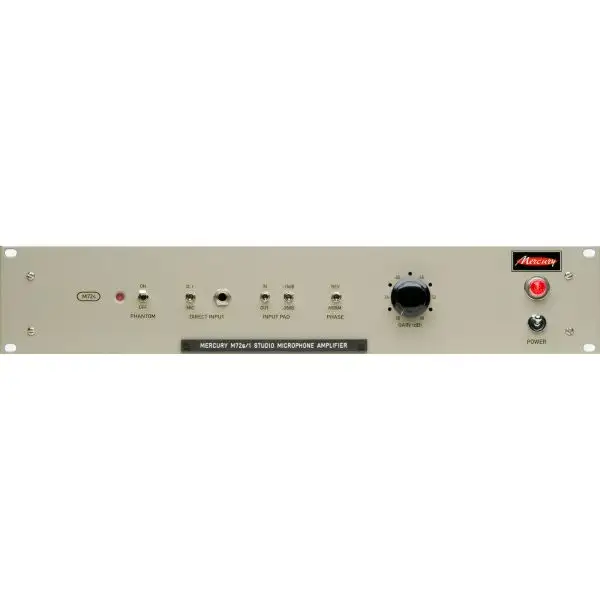
The Mercury M72s/1 (Mk. III) is the mono version of the Tube Mercury Studio Microphone Amplifier, the M72s. The Mercury M72s is based on the most sought after vintage amplifier module, the Telefunken/Siemens V72s, which is most famous for being used in REDD.37 consoles, which was used on all the early Beatle recordings by George Martin at Abbey Road Studios in London, England.
The Mercury M72s is based on the very rare V72s module used in consoles due to a minimal amount made. The more common V72 amplifier modules (not marked with lower case s, ie V72s) were later modified and have been sold for many years as outboard preamplifiers all over the world. Neither of these amplifier modules have been available new for more than 50 years. So, working units have become extremely rare, very expensive and, in some cases are now in need of much repair.
Regardless of cost, the uniquely musical tonal characteristics of these amplifiers has made them the prized possession of many engineers lucky enough to get the vintage modules, and a “secret weapon” for many studio musicians. Mercury Recording Equipment is proud to have a faithful reproduction in the M72s.
Features:
The Gain of the Mercury M72s is variable from 28dB to 58dB, in 3dB increments, controlled with a high quality rotary switch. Also, there is an option of a selectable Input Pad of -16dB or -28dB for even more control. Additionally, when the -28dB pad is engaged and it is set at the lowest gain setting (28dB) you can run signal through the M72s to add warmth and tonality to any tracks, mixes, keyboards, drum machines, samples etc. There are also all the modern features you expect on a new piece of equipment: Phantom Power (on/off) , Phase (Polarity) Reversal, and the amazing sounding F.D.I. (FET Direct Input) circuit per channel.
The Mercury FDI (FET Direct Input), a proprietary J-Fet circuit, based on a class-A tube topology. The Mercury FDI is designed to reproduce every nuance of a direct recording, while the circuit lets the tube or solid-state character of the amplifier determine the overall tone. The instrument DI signal is sent through the entire microphone pre-amp circuitry, including Mercury’s custom, massive input transformers, so that the individual character of each pre-amp comes through.
The Mercury M72s has the rich lows and punchy mids giving you that ‘instant’ vocal tone, a realistic acoustic guitar tone, or add punch to a bass guitar. The same reaction to instruments or source as the vintage module but with slightly more open high end and openness. The Mercury M72s Studio Microphone Amplifier has the ‘vintage’ tone and break up like the original circuit but it is a bit more musical over all (not cleaner, more musical, there is a huge difference).
Specifications:
- Mic Input Impedance: Approx. 2k
- Suggested Source Impedance: Approx. 200 ohms
- Input Impedance with -28dB Pad: Approx. 4k
- DI Input Impedance: 2M ohms
- Internal Output impedance: 30-50 ohms (depends on gain setting)
- Suggested Minimum Load: 500 ohms
- Max. Mic Signal Input Level (@ 20 Hz): +34dBu with -28dB Pad engaged / +6dBu with
- Pad not engaged
- Max. Output Level: +22dBu
- Frequency response: 20 Hz to 20 kHz +/- 0.5dB
- Harmonic Distortion: All musically related low orders of harmonics, with no
- significant order above 5th.
- Tubes: 2x EF806s, per channel
- Rack Size: 2U
| Condition | New |
|---|---|
| Tube or Solid State | Tube |
| Channels | Single-Channel |
| Chassis | 19-inch, Rack-mount |
| Rack Spaces | 2U |
| Direct Input | Yes |
| Digital I/O | No |
Be the first to review “Best Pirce 🔔 Mercury M72s/1 MKIII 🧨”
Related products
Mic Preamps
Reviews
There are no reviews yet.