
Original price was: $443.00.$95.99Current price is: $95.99.
- Secure Shopping with Safe Payments
- Have the best deals
- Sustainable materials, for a better tomorrow.
- Shop with Confidence, Pay Safely

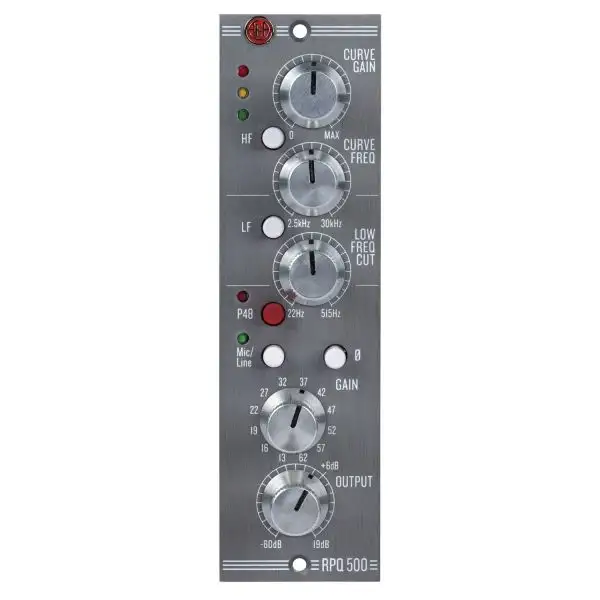
The AEA RPQ500 module, designed after the successful RPQ preamp, provides the same ultra-clean, high-gain signal path that has earned AEA preamps their great reputation, but in a 500 series package. JFET circuit topology provides all the dynamics, subwoofer bass, and fast transients that your microphones can record. The NoLoad™ input impedance above 10K Ohms means the RPQ won’t load down a mic and change its sound. Low Energy Storage™ circuit design instantly recovers from overloads for superior dynamic performance. The original RPQ with CurveShaper™ was designed to fully capture every nuance of ribbon microphones: vintage or modern, passive or phantom powered. Engineers have discovered that the RPQ500 also complements their moving coil, condenser mics. By virtue of its sonic qualities and versatility, the VPR Alliance approved AEA RPQ500 is the tool of choice for all microphones whenever a true and pristine signal path is desired.
Two Peas in a Pod: Musical Preamp, Sweet EQ
The CurveShaper’s™ high-frequency filter boost enables you to add a little extra “presence” or “air” to your source. The circuit functions similarly to a conventional parametric shelving boost, but with a significant difference: the slope varies as both the CurveShaper™ and HF Gain controls are adjusted. This unique bell curve was designed with the intention to compensate for the high-frequency roll-off that is inherent to most ribbon microphones. But beyond ribbon mics, the smooth HF filter is remarkably well suited for brightening up condenser mics used at a distance, restore presence in overly “dry” acoustical environments, or even as a clean and transparent air-band boost on the 2-bus.
The CurveShaper’s™ low-frequency control easily removes boxiness and boominess in a fast and unobtrusive way. Ribbon mics are capable of delivering strong subwoofer lows, and can have a significant bass proximity effect. Such strong low-frequency content can mask high-frequency intelligibility, so the tunable LF filter was engineered to tame low-frequency energy to appropriate levels. Its -20dB shelving curve is ideally suited to reduce excessive proximity effect, opening up new possibilities to use ribbon mics in close-up applications.
Your Sound At Your Fingertips
Features:
- One channel with 81dB of sweet and quiet JFET gain for all mics
- High frequency CurveShaper™ EQ and low frequency proximity control
- Mic and line inputs for mixdown EQ versatility
- Switchable phantom power, polarity, line/mic, and EQ inserts
- NoLoad™ 10k Ohm high-impedance circuitry providing better overall transients, frequency response, and higher output sensitivity
Specifications:
- Gain at 1 kHz: 81 dB of gain at 1kHz balanced-in to balanced-out in Microphone Input Mode
- Noise figure RMS A-weighted:
- Noise figure RMS unweighted:
- EIN:
- Frequency response: -3 dB 100 kHz
- THD:
- Input impedance: 10 kOhms
- Balanced Line Input Impedance: 20 kOhms
- Input Gain control: Twelve-position switch provides from +13 dB to +62 dB of gain for the preamplifier circuit, as measured between the input and the before the output line driver
- Switched LF Shelving filter: -3 dB break-frequency tunable from 18 Hz to 360 Hz; maximum reduction -20 dB
- Switched CurveShape EQ: +3 dB break-frequency tunable from 2.5 kHz to 30 kHz; HF gain adjustable from +0 dB to +18 dB; the slope of the HF filter varies interactively and directly with the CurveShaper™ frequency and gain settings
- Color LEDs: Green, Yellow, Red
- XLR output maximum level into 600Ω load: +28 dBu, balanced; 0 dBu = 0.7746 V RMS
- XLR connectors polarity: Pin-1 is ground, pin-2 is high, pin-3 is low
- LED signal level indicators: Green snaps on at -6 dBu, red snaps on at +23 dBu, and yellow varies in brightness with level from -3 dBu to +20 dBu
| Condition | New |
|---|---|
| Unit Weight | 11.7, oz |
| Tube or Solid State | Solid, State |
| Channels | Single-Channel |
| Chassis | Module |
| Module Type | 500, Series |
| Module Slot Count | 1, Slot |
| Input Connectors | Analog, XLR |
| Output Connectors | Analog, XLR |
Be the first to review “Best deal 🤩 AEA RPQ500 500 Seres Microphone Preamp 🎉”
Related products
500 Series Preamps
Best deal ⭐ Rupert Neve Designs Portico 542 500 Series Tape Emulator 👍

500 Series Preamps
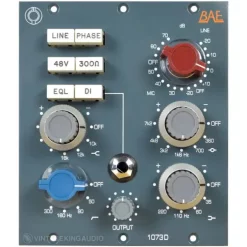
Best Sale 😍 Heritage Audio 73JR II 500 Series Microphone Preamp And DI ❤️
500 Series Preamps
500 Series Preamps
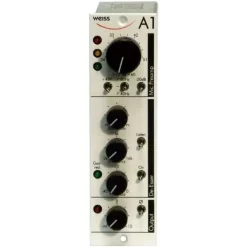
Best deal 🥰 Weiss A1 500 Series Microphone Preamp/De-Esser 🤩

500 Series Preamps
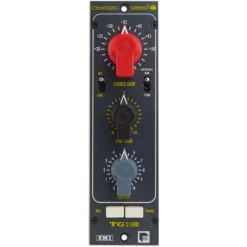
Deals 🥰 Shadow Hills Industries Mono GAMA Microphone Preamp 😍
500 Series Preamps

500 Series Preamps
500 Series Preamps
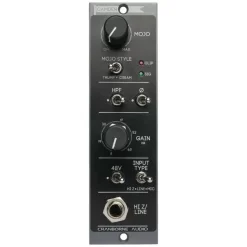
Deals 😍 Cranborne Audio Camden 500 Series Microphone Preamp 🔥
Reviews
There are no reviews yet.